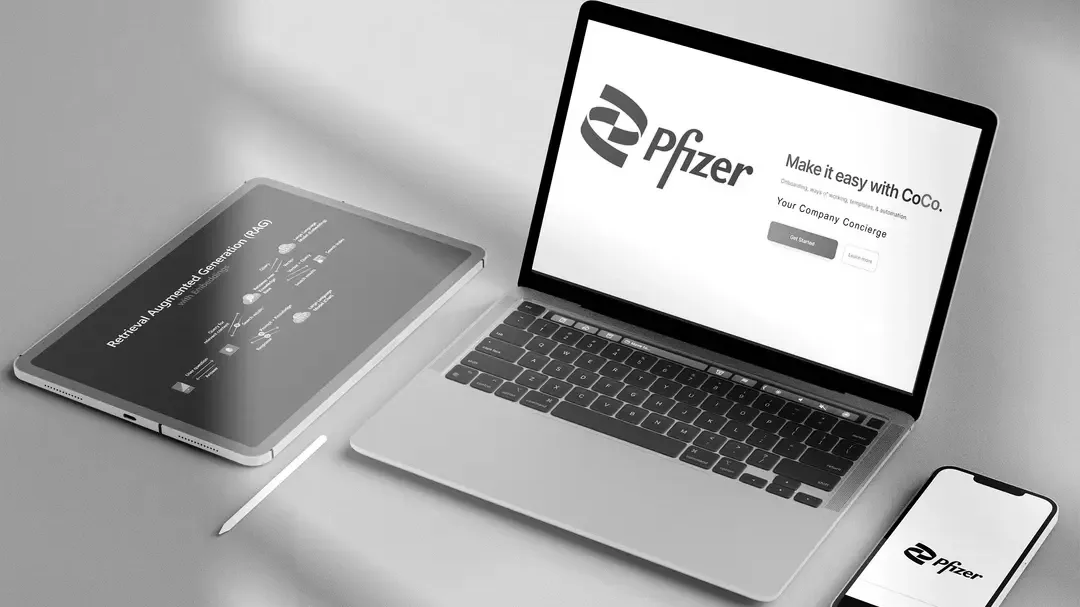
In 2024, at Publicis Groupe, I led the onboarding and automation of the Comirnaty team within Pfizer CoLab, on a $460K operating budget from Pfizer leadership. With four months to prepare for major label updates, I reframed the workforce bottleneck as time to proficiency and proposed CoCo: a voice and text retrieval assistant grounded in approved operating material.
Launching CoCo for regulated marketing operations
- Azure · AI product launch · Voice and text retrieval · Four-month launch deadline
- Product & program lead$460K operating budget10 months
 Microsoft Azure
Challenge
The program had to expand delivery capacity without separating onboarding from active brand work. New specialists needed role guidance, approval rules, tool instructions, and shared terminology before they could contribute. That knowledge was distributed across Workfront, SharePoint, Jira, Smartsheet, and the enterprise content platform.
- Two vaccine brands and a four-month deadline
- Five operating platforms
- Regulated work moving through definition, review, submission, deployment, and monitoring
2 brands5 operating platforms4-month deadline
| Knowledge a new specialist needs | Where it lived | Owner | Format | Gap |
|---|---|---|---|---|
| Role guidance | SharePoint team sites | Account leads | Decks, docs | Inconsistent by brand |
| Approval rules | Enterprise content platform | Medical, legal, regulatory | Process documents | Not linked to live work |
| Tool instructions | Workfront · Jira · Smartsheet | Platform owners | Wiki pages, tickets | Split across 3 tools |
| Shared terminology | — | No owner | Tribal knowledge | No glossary |
| Label-update status | Workfront | Project managers | Tasks | Visible to PMs only |
Action
I defined the operating problem, proposed CoCo, set the product requirements, coordinated delivery, and connected the roadmap to the label program. We built on Azure for enterprise identity, language, speech, and hosting services; limited retrieval to approved sources; supported voice and text; and kept the first release bounded to retrieval, guided learning, and in-workflow assistance.
The product organized knowledge into four modes—Know, Role, Grow, and Flow—and combined authenticated access, a React interface, indexed retrieval, speech services, and usage telemetry.
Content producer[Person]
MLR reviewer[Person]
Brand manager[Person]
New specialist[Person]
CoCo[Software system · Azure · React interface]Voice and text retrieval assistant, limited to approved sources
KnowRoleGrowFlow
Microsoft Entra ID[Authenticated access]
Azure AI Search[Indexed retrieval]
Azure AI Speech[Voice in and out]
SharePoint[Approved documents]
Content platform[Approved material]
Workfront[Project context]
UsesExternal systemUsage telemetry captured for every answer
Result
CoCo shipped as a working AI product and a repeatable onboarding model designed around the launch constraint. The program showed how a delivery bottleneck could become a focused product decision without weakening governance.
The work also established durable requirements for later AI programs: source ownership, evaluation criteria, access control, and provider portability had to be designed in rather than added after launch.
KnowRoleGrowFlow
Who reviews a label-update change to a brand web page, and what do I submit?
Label-driven changes go through full medical, legal, and regulatory review before they publish.
- Open a change request in Workfront using the label-update template [1]
- Attach the approved label text and the marked-up page [2]
- Route to review; the project manager tracks the submission date [1]
[1] Workfront · Label-update request template[2] SharePoint · Review submission checklist · approved
Answer limited to approved sourcesHelpfulNot helpfulAsk by voice
Reference architecture · Microsoft Azure
Governed generative AI knowledge assistant
A private, identity-bound retrieval-augmented generation (RAG) platform that answers voice and text questions only from approved operating material. Every service is reached over private endpoints, and evaluation sits on the delivery path rather than after it. See all four reference architectures.
Azure subscription · Landing zone (hub and spoke virtual network)
Approved knowledge
SharePoint OnlineApproved libraries
Labels & SOPs
Training material
Sync
Enterprise services
Microsoft Teams
Workflow tools
Learning system
Graph API
Change signals
Label updates
Review approvals
Process owners
Events
Ingest & prepare
Blob StorageLanding zone
Logic AppsChange triggers
Document IntelligenceLayout extraction
Azure FunctionsChunk & enrich
Knowledge & grounding
Azure AI Search
- Extracted
- Chunked
- Embedded
- Hybrid index
Embedding modelAzure OpenAI
Cosmos DBConversation history
Orchestration & models
Foundry Agent ServicePrompt, tools, policy
Azure OpenAIChat model
Azure AI SpeechSpeech in and out
Content SafetyInput & output filters
Index
Retrieve
Chat & voice experience
App Gateway + WAF
App ServiceChat UI
Respond
Specialists & new hires
Evaluation & feedback
Foundry evaluationsGroundedness
Feedback loop
Respond
Product & review owners
Operations
Application Insights
Log Analytics
Respond
Platform operations
Identity, network & governance
Microsoft Entra ID
Managed identities
Key Vault
Private LinkPrivate endpoints
Azure FirewallEgress control
Azure Policy
Defender for Cloud
Microsoft PurviewClassification & lineage
100%
Drag to pan · Ctrl/⌘ + scroll to zoomDrag to pan · Pinch to zoom
Ingest & prepare
Approved documents land in Blob Storage on change. Document Intelligence extracts layout and Functions split content into governed chunks with source metadata.
Knowledge & grounding
Chunks are embedded and written to a hybrid (keyword and vector) Azure AI Search index. Conversation state is kept in Cosmos DB.
Orchestration & models
The agent applies the system prompt and tools, retrieves grounding passages, calls the chat model, and passes inputs and outputs through Content Safety.
Experience & evaluation
Users reach the app only through Application Gateway with WAF. Groundedness evaluations and user feedback gate releases; telemetry flows to Application Insights.
Identity, network & governance
Entra ID and managed identities replace keys, every data service sits behind private endpoints, egress is forced through Azure Firewall, and Policy and Purview hold the evidence.