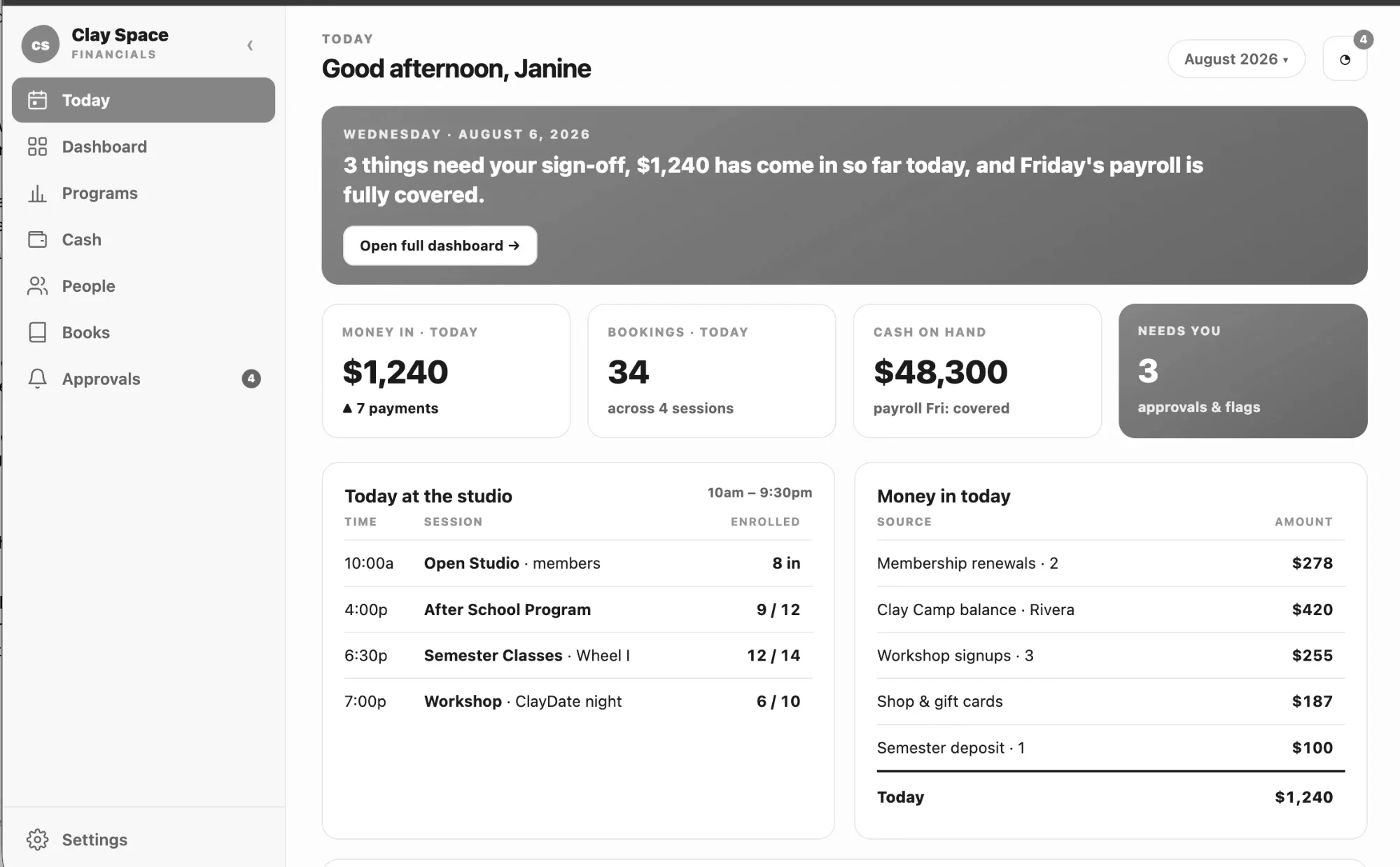
Clay Space runs a Brooklyn ceramics studio on twelve tools that do not talk to each other. I wrote the brief and statement of work for Studio ONE, a single operating surface of fourteen modules, from registration and memberships to kiln firing, payments, and owner reporting, and I am delivering it as a solo build from August 2026 to February 2027.
Studio ONE: one operating platform for Clay Space
- Google Cloud · Custom platform · 14 modules · 8-month program · In progress
- Platform architect & builder$230K program value8 months
 Google Cloud

Challenge
Sawyer, Typeform, Acuity, WooCommerce, Squarespace, Mailchimp, Dropbox, and Square and Stripe each held part of the business, and none of them shared data. Staff re-keyed the same information by hand, members juggled five logins, and every clay purchase and firing fee was charged on its own, so per-transaction payment fees stacked up.
- Twelve disconnected tools
- Five logins for a member
- Payment fees charged on every small transaction
12 tools5 logins per memberData re-keyed by hand
| Tool | Used for | Replaced by Studio ONE module |
|---|---|---|
| Sawyer | Class registration and bookings | Registration & household accounts |
| Typeform | Forms and intake | Registration (versioned waivers, consent) |
| Acuity · Calendly | Private-lesson scheduling | Automation & workflows |
| WooCommerce | Online shop | Inventory & shop |
| Squarespace | Public website | Integrations & web shell |
| Mailchimp | Email to members | Notifications & messaging |
| Dropbox | Documents and files | Staff operations hub |
| Square · Stripe | Card payments, charged one by one | Payments, ledger & reconciliation |
QuickBooks and Gusto stay in place and are fed by the platform rather than replaced.
Action
I ran paid discovery with the studio's staff before any build, then scoped Studio ONE as fourteen modules: payments and reconciliation, registration and household accounts, memberships and bench time, firing and kiln tracking, member and staff portals, a staff operations hub, inventory and shop, messaging, workflow automation, native apps, owner reporting, integrations, and a platform foundation of role-based access, a durable audit log, and human approval gates. I am building it on Google Cloud as a Next.js web app backed by Python and Rust services. Payments move to ACH first with weekly batching, which ends the fee stacking. QuickBooks and Gusto stay in place and are fed by the platform rather than replaced.
Delivery runs as thirteen two-week sprints with milestone gates M0 to M4. The first four sprints are a scope-firming period, and each milestone gets a ten-business-day review. Generative AI is deliberately deferred to a second phase: the studio does not need it to operate, and the first release should earn trust on the fundamentals.
Result
In progress, August 2026 to February 2027. The platform is designed to pay for itself within its first year, through retired subscriptions and recovered payment-processing fees. The studio owns its data, and the price is fixed at the end of Definition with a cap that includes every change request.
What will be measured: subscriptions retired, processing fees recovered, hours of manual re-keying removed, and logins per member, from five to one. Results will be added here when they are in.
Reference architecture · Google Cloud
Studio ONE: one operating platform for a ceramics studio
Clay Space ran its studio on twelve tools that did not share data, so staff re-keyed records by hand and members juggled five logins. Studio ONE replaces them with one platform: integrations import history and keep data in sync while each tool is retired, one database becomes the record for households, memberships, firings, and payments, and members, staff, and the owner each get one place to work. QuickBooks and Gusto stay in place and are fed by the platform. Generative AI is deferred to Phase 2. See all four reference architectures.
Google Cloud project · Studio ONE
Booking & registration
SawyerClasses
Acuity · CalendlyPrivate lessons
TypeformForms & intake
Webhooks & APIs
Shop, site & email
WooCommerceShop
SquarespaceWebsite
MailchimpEmail
APIs
Payments & files
Square · StripeCard payments
DropboxDocuments
Import & sync
Integrate & migrate
Application IntegrationSaaS connectors
Pub/SubEvent bus
Cloud SchedulerSync jobs
Cloud StorageImport staging
One source of truth
Cloud SQL for PostgreSQL
- Import
- Match & de-duplicate
- Unified record
Ledger & audit logDurable
BigQueryReporting
Studio ONE platform
Cloud RunPython & Rust services
Identity PlatformOne sign-in
Workflow engineRules & approvals
Cloud TasksEmail, SMS & push
Load
Serve
Member portal & app
Next.js web appBook, pay, self-manage
Native appPush notices
Use
Members & families
Staff portal
Rosters & firingsAttendance, kiln log
Use
Staff & instructors
Owner reporting
Owner dashboardOn BigQuery
QuickBooks · GustoFed, not replaced
Use
Owner
Platform foundation
Role-based access
Durable audit log
Human approval gates
Secret ManagerNo raw card or bank data
Cloud KMS
Cloud SQL backupsPoint-in-time recovery
Cloud Monitoring
100%
Drag to pan · Ctrl/⌘ + scroll to zoomDrag to pan · Pinch to zoom
Integrate & migrate
Application Integration connects to Sawyer, Acuity, WooCommerce, and the other tools through connectors and webhooks. History is imported once, and sync keeps data current while each tool is retired.
One source of truth
Records are matched and de-duplicated into one Cloud SQL database for households, memberships, bookings, firings, and payments, with a durable ledger and audit log. BigQuery receives a copy for reporting.
Studio ONE platform
Python and Rust services on Cloud Run hold the fourteen modules behind one sign-in, and a Next.js web app serves members, staff, and the owner. A rules engine runs workflows and approvals, and notices go out by email, SMS, and push. Generative AI is deferred to Phase 2.
Use
Members book, pay, and manage their membership in one portal and app; staff run rosters, attendance, and the kiln log; the owner sees the business in one dashboard, and QuickBooks and Gusto are fed by the platform.
Platform foundation
Role-based access, a durable audit log, and human approval gates; no raw card or bank credentials are stored, and the studio owns its data.